The Elements of a Great Surf Photo (And How to Capture Them)
The best surf photos aren't luck. Learn the five elements that make a great surf shot, from golden hour light and clean waves to sharp focus and dramatic Portuguese backdrops.
The Elements of a Great Surf Photo (And How to Capture Them)
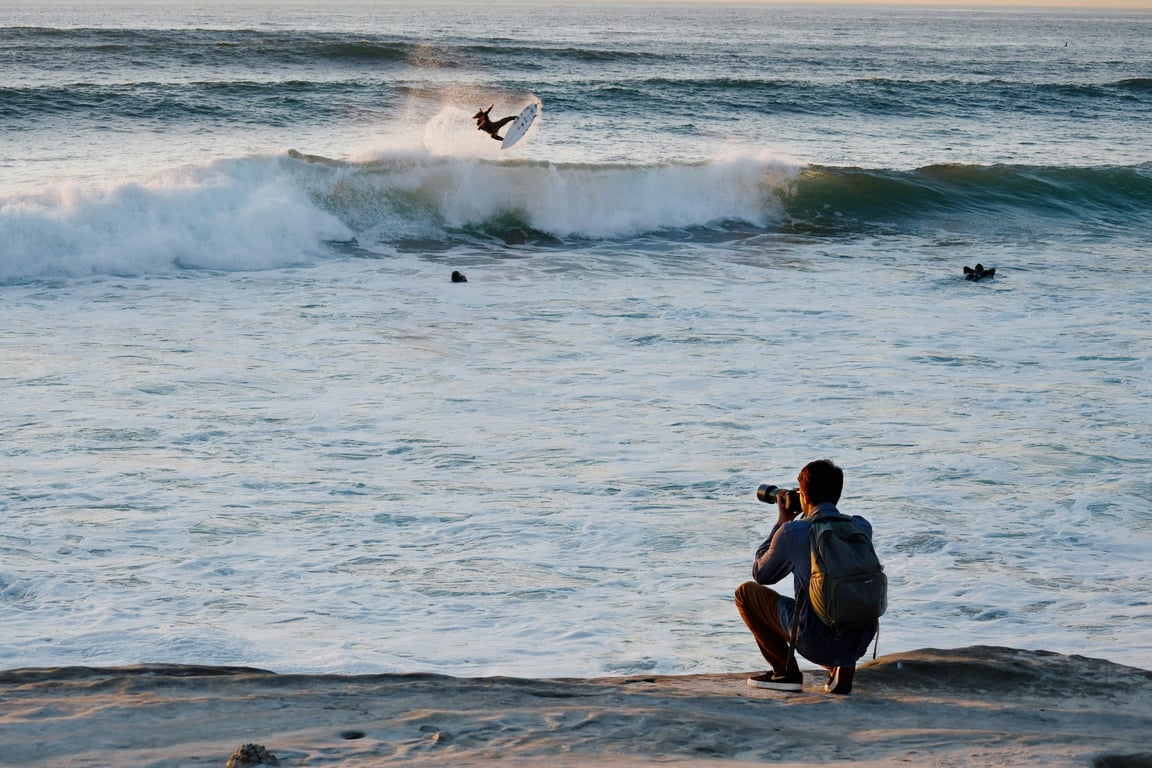
Great surf photos don't just happen by driving to your local break, pulling out your camera, and firing away. The work of photographers like Morgan Maasen, Chris Burkard, and Russell Ord didn't blow up by accident. Their images are the result of being in the right place, at the right moment, with the right conditions, and then pushing further than most people are willing to go.
When you're starting out in surf photography, it's not always obvious what separates an average shot from a unforgettable one. It's not just the surfer. It's not just the wave. It's a combination of various elements coming together, and when they do, you notice it immediately and the image just works.
Here's a breakdown of what those elements actually are, how to start seeing them, and how to bring them into every surf photography session.
1. Light
Light is the one thing that's really hard to fake. You can sharpen an image during post-editing, fix the crop, enhance the colours, but you can't manufacture good light after the pictures have been taken. It either was there or it wasn't.
The same wave, the same surfer, the same manoeuvre, shot in flat midday sun versus golden hour, will look like two completely different photos. One feels alive, textured, and cinematic. While the other looks more like a simple snapshot.
The best times to shoot are:
Sunrise — the angle of the sun is low and the rays hit the water sideways, allowing the sun to bring out the texture in every ripple
Late afternoon — does the same thing from the other direction, often with more dramatic colour in the sky
Slightly overcast days — the light is soft and even, no harsh shadows and no blown-out highlights on the water
Harsh midday sun is definitely the hardest light to work with. It often flattens the images, dulls the colour in the water, and makes spray harder to see against a bright sky. That said, afternoon shooting is still very much possible if you come prepared! Figure out where the sun sits at your local break, make sure it's in front of the surfers rather than behind them, and bring a lens filter. A polarising lens filter sits on the front of your lens and helps cut through glare and reflection on the water, which is exactly what afternoon light throws at you. The result is richer colour in the water, better contrast between the surfer and the surface, and spray that actually shows up in the frame rather than washing out against a bright sky. Get those things right and you can walk away with some great shots.
Overall, we recommend chasing the golden hours. It's the simplest upgrade you can make, and it costs nothing.
Not all waves are created equal, and as a photographer, you need to start reading them the same way surfers do.
A good wave for photography:
Breaks cleanly and predictably
Has a defined lip and pocket
Offers the surfer room to actually perform
Holds its shape long enough to capture the moment
Messy, closeout waves are frustrating to shoot. Everything happens at once, it's over in a second, and there's nothing to anticipate, just react and hope. Clean, lined-up waves that peel across give you a read on where the action is heading. You can position yourself for the best section, watch the surfer set up, and be ready before they even start their turn.
Spend the first ten minutes of any session just watching. Where are waves breaking best? Which section is the most consistent? Which direction are surfers going? That ten minutes of observation will produce better results than an hour of shooting blind.
Mathyas Kurmann / Unsplash
3. Focus
A technically sharp image is non-negotiable. You can have perfect light, a beautiful wave, and a surfer throwing the best turn of their session, and if the shot is blurry, it's gone. Surfers want to see themselves clearly. The expression, the spray, the exact position of the board. That detail is the whole point, and how else are they going to prove they actually got barreled?
The challenge is that everything in surf photography is in constant motion. The surfer, the water, the spray, and sometimes even you. Your focus system needs to work with that, not against it.
Autofocus settings:
Use continuous autofocus — AF-C on Nikon and Sony, AI Servo on Canon. This keeps the camera tracking a moving subject frame to frame rather than locking on a fixed point
Set a small focus zone or single point — wide-area AF will grab the wave or whitewater instead of the surfer every time
Aim for the upper body — the torso and head stay relatively stable compared to arms and feet, which are always moving
Shutter speed:
1/1000s minimum for freezing motion cleanly
1/1600s to 1/2000s in good light for crisper spray and sharper edges on fast turns
No amount of accurate autofocus compensates for a shutter speed that's too slow
4. Surf Manoeuvres
Good light and sharp focus get you halfway there. What happens on the wave is the other half.
Surfers are performing, carving, snapping, airing, threading barrels. Your job is to capture the peak of that performance: the single frame where the commitment, speed, or style is at its absolute maximum. That's the shot that surfers are after and that's the one that stands out in a sea of photos.
The moments that tend to produce the strongest images:
Top turns and snaps — board fully engaged with the lip, spray exploding off the back
Cutbacks — surfer arcing hard back into the power zone
Airs — any moment the board leaves the water entirely
Barrel riding — even a small, crouched tube shot carries an energy that's hard to beat
To get these consistently, you have to anticipate rather than react. Watch the wave forming ahead of the surfer. When you see a section about to throw, that's where the turn is coming. Be framing and tracking before it happens, not the moment it does. The photographers who nail this stuff aren't faster on the trigger, but they've just watched enough surfing to know what's about to happen a beat before it does. Spend time at the beach even when you're not shooting. Watch surfers. Learn how they read and respond to waves.
Some shots stand out not because of what the surfer did, but because of the world they did it in.
Barrels and long, peeling waves give you the canvas. A hollow, pitching tube is the defining image of surf photography for a reason. The compression, the spray, the surfer framed inside the lip. Even a small, clean barrel photographed well is a standout image. Long open-faced waves are a different kind of gift. They let the surfer link manoeuvres and give you time to track the whole ride, which means you might walk away with five or six strong frames from a single wave rather than one.
But once you've got the wave, look beyond it. Every surf destination in the world has something unique to offer visually, whether that’s a dramatic clifftop, a city skyline, a volcanic coastline, or a stretch of untouched jungle. The backdrop is part of the story, and the best surf photographers know how to use it.
Some of the most visually rewarding breaks in the world to shoot:
Pipeline, Hawaii — the most photographed wave on the planet for a reason. Heavy barrels, shallow reef, and light that does something magical in the early morning
Uluwatu, Bali — long peeling lefts with clifftop temples framing the horizon, one of the most beautiful settings in surfing
Hossegor, France — powerful beach breaks, pine forests, and a surf town atmosphere that is uniquely European
Snapper Rocks, Australia — one of the most iconic points in the southern hemisphere, with long peeling rights and the warm Gold Coast light working in your favour
Nazaré, Portugal — home to the biggest waves ever surfed, with the iconic fort on the cliff watching over every session
The practical side is learning to use your environment intentionally. If the sky is doing something interesting, adjust your angle to include it. Shoot wider than you normally would. Let the landscape breathe inside the frame. A surfer doing a solid turn in front of a dramatic backdrop will always outperform a better manoeuvre shot against a flat, grey horizon. When the surfing is compelling and the world around it is beautiful, that's the money shot.
Jarno Colijn / Unsplash
Final Thoughts
A great surf shot is rarely luck. It's the result of showing up in good light, reading the ocean well, having your camera dialled in, and staying alert for the moments that matter.
Before every session, run through it quickly:
Is the light working?
Are the waves offering something worth shooting?
Is my focus system set up correctly?
Am I positioned to anticipate the manoeuvre rather than react to it?
Is there a backdrop or a special wave worth waiting for?
The more intentionally you think about each element, the more consistently you'll come home with images worth sharing. Great surf photography is a skill, and like any skill it improves with awareness and repetition. Get out there, stay patient, and keep evolving.
You can also browse the work of Wave Cam photographers shooting across Portugal at wavecam.co/photographers. Cristiano Sarmento in Ericeira, Mauricio Moura in Caxias, Miguel Delgado in Nazaré, and the rest of the community are a great source of real-world inspiration for what's possible with the right eye and the right conditions.
Originally from Toronto, I’m now based in Lisbon studying Marketing and Advertising. I moved here for the ocean and now spend most of my days surfing, shooting pictures, and doing anything that keeps me outside and active.
You don’t need expensive gear to shoot great surf photos. Learn how to improve your surf photography with a Budget setup using simple tips on positioning, timing, and camera settings.
 Made with Bullet