How to Improve Your Surf Photography with a €500 Setup (Beginner Tips)
You don’t need expensive gear to shoot great surf photos. Learn how to improve your surf photography with a €500 setup using simple tips on positioning, timing, and camera settings.
Surf photography looks expensive. And yeah, it can be. Scroll through any lineup and you’ll see big lenses and serious setups. It’s easy to think you need all of that to get started. But you don’t.
If you’re getting into surf photography and wondering how to shoot better photos without expensive gear, this will help.
You can shoot great surf photos with a €500 setup. The difference isn’t the gear, it’s how you use it. Where you stand, when you shoot, and how well you read the wave. Starting with less actually works in your favour. It forces you to focus on what really matters.
Here’s how to make your setup go a lot further.
1. Get Closer to the Action
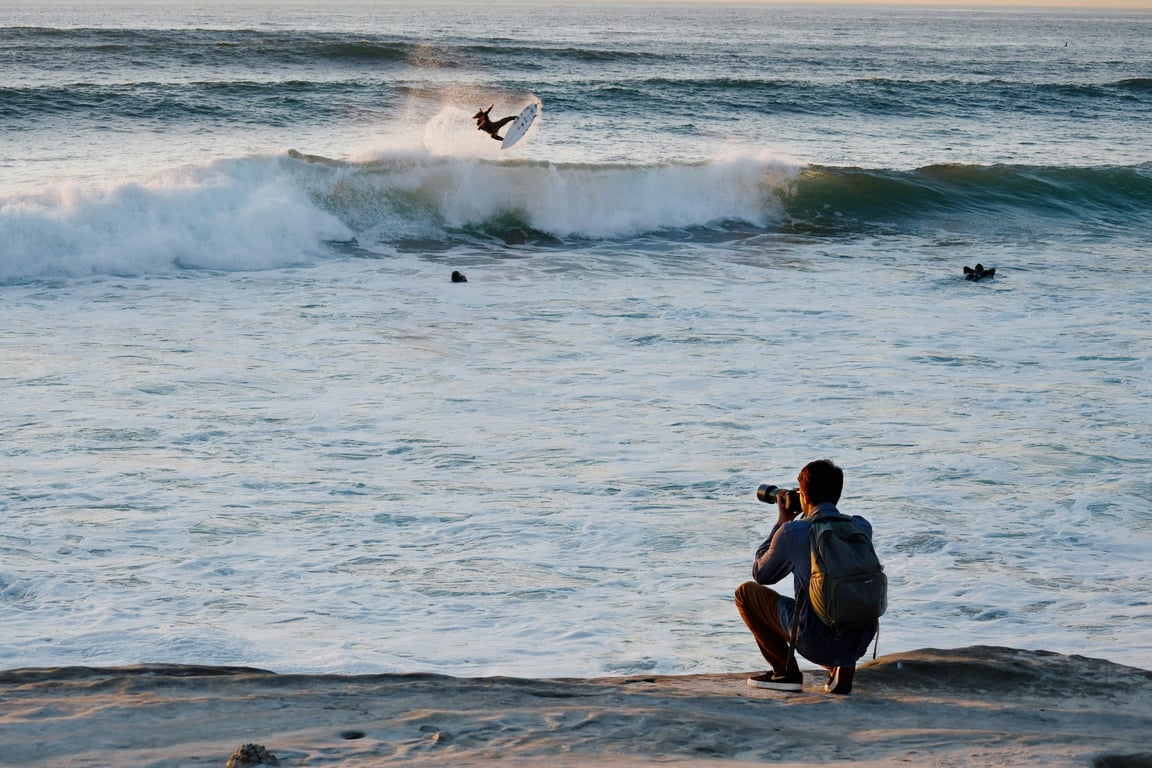
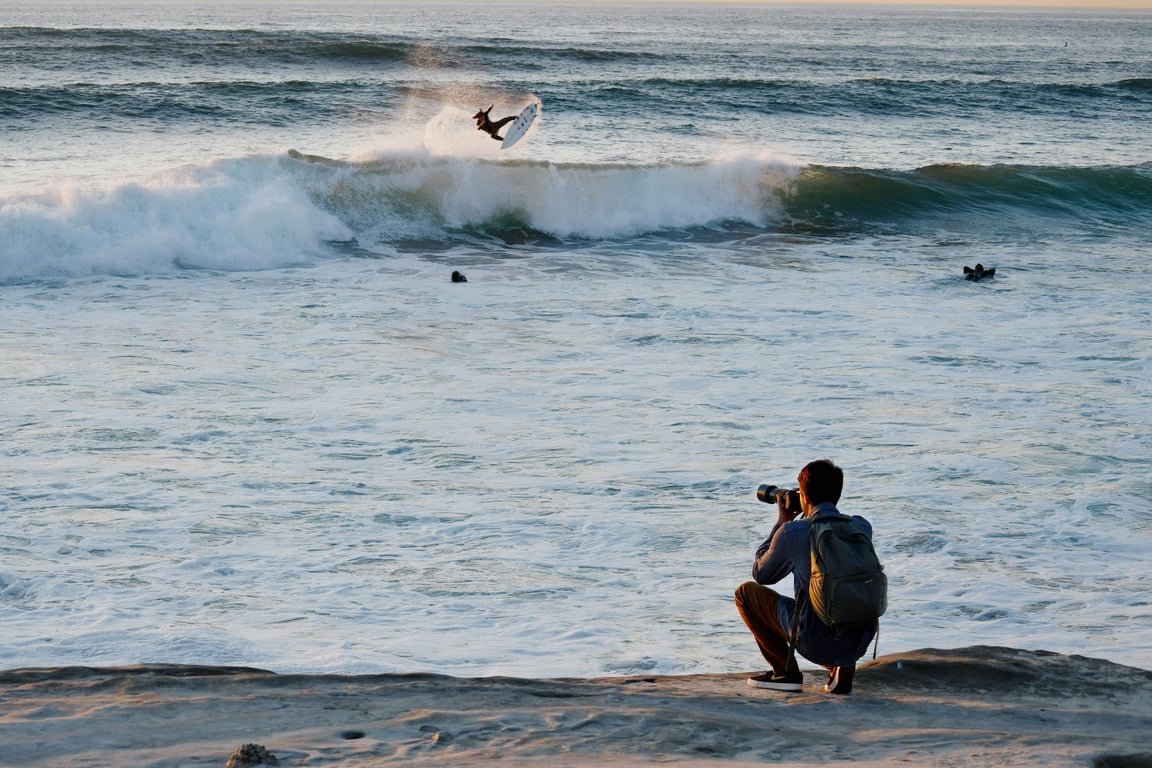
This is the biggest game changer and definitely one of our most important tips. Budget lenses usually lack strong zoom and sharpness, so if you’re shooting from far away, your images will often look soft and lack detail. Surfers care about seeing themselves clearly, not as tiny figures on a wave. I mean, how else can they prove that they actually got barreled?
So instead of thinking “I need more zoom”, think “How do I get closer?”
Look for spots that bring the action closer to you:
Point breaks where surfers follow a predictable line
Sandbanks that peak near shore
Jetties, rocks, or piers you can safely shoot from
In Portugal, beaches like Santo Amaro, Costa da Caparica, Praia de São Pedro do Estoril, Figueira da Foz, and Caxias can offer closer shooting opportunities depending on the conditions. The key is to explore and find angles where the wave breaks closer to land.
If you can’t get closer, get higher. Shooting from cliffs, dunes, or elevated walkways helps you frame the surfer better, clean up the background, and make your lens feel more powerful than it actually is.
Max Harlynking / Unsplash
2. Shoot in Good Light (One of the Most Important Surf Photography Tips)
If your photos look flat, noisy, or just a bit off, it’s probably not your gear and more likely the lighting. Entry-level cameras struggle in low light, which leads to grainy images, slow shutter speeds, and dull colours.
We recommend shooting in:
Early morning
Late afternoon
Bright but slightly overcast days
These conditions will give you sharper images, better colours, and much more room to work with your settings. Even photographers with expensive setups chase good light. It really is one of the simplest ways to instantly improve your photos.
3. Learn Your Optimal Camera Settings for Surf Photography
You don’t need to go full manual straight away, but you do need to take some form of control.
Start simple:
Shutter speed: 1/1000s or faster. This freezes motion so the spray and turns stay sharp
Aperture: f/5.6 to f/8. This keeps your subject sharp while giving you enough depth of field
ISO: As low as possible. Higher ISO = more grain, especially on cheaper cameras
If you are wondering why ISO matters, think of it like brightness. The higher it goes, the more your image brightens, but the more grain you introduce. That is why good light helps so much.
Try using shutter priority mode if manual feels overwhelming. It lets you control motion while the camera handles the rest.
The more you experiment, the more you will understand how your camera behaves in different conditions.
4. Composition Beats Equipment
You can have the best gear in the world and still miss the shot. Or you can have a €500 setup and nail it. The difference is what you choose to include in the frame.
Focus on:
Clean backgrounds with minimal distractions
Positioning the surfer in the pocket, not outrunning the wave
Capturing spray, the lip, or the barrel
These are the details that surfers actually care about. Instead of shooting everything, be selective. A clean, well-timed image will always beat a cluttered one with better zoom.
5. Learn Timing and Use Burst Wisely
Burst mode helps when shooting surf action, but it’s not the answer. Cheaper cameras don’t have endless buffers. If you just hold the shutter down, you’ll miss the actual moment anyway.
What matters more is reading what’s about to happen.
Watch how sets roll in
Learn where waves break best
Follow one surfer for a few waves
Predict when they will hit the critical section
The more you understand the ocean, the less you need to rely on luck.
6. Use Autofocus Intentionally
Do not let your camera guess what matters.
Set your camera to:
Continuous autofocus (AF-C or AI Servo)
A single focus point or small zone
Keep that focus point on the surfer, ideally their upper body. This reduces the chance of your camera focusing on the wave or whitewater instead.
7. Hold Your Shot Steady
Sharpness is not just about your lens. Small movements become more noticeable when zoomed in, especially with budget gear.
Keep your elbows tucked in
Lean against something solid when possible
Use a monopod or tripod if you have one
Simple stability can make a big difference in image quality.
8. Think Like a Surfer
This is an underrated skill. If you understand when a surfer will paddle, turn, or go for a maneuver, you will be ready before it happens.
Pay attention to:
Where surfers sit in the lineup
Which waves they choose
How sections of the wave form
The better you read the ocean, the better your timing becomes.
Final Thoughts
A €500 setup is not a limitation. It is a strong starting point.
It forces you to:
Move your feet instead of relying on zoom
Pay attention to light
Learn timing and positioning
Understand your camera properly
Those are the skills that matter. Focus on getting closer, choosing the right conditions, and being intentional with your shots, and you can create images that stand out on platforms like Wave Cam. In surf photography, awareness and positioning will take you further than gear ever will, so get out there, keep shooting, and keep learning.
Originally from Toronto, I’m now based in Lisbon studying Marketing and Advertising. I moved here for the ocean and now spend most of my days surfing, shooting pictures, and doing anything that keeps me outside and active.
 Made with Bullet